
Cookie Craft

Cookie consent for Shopware 6

Cookie consent for Shopware 6, installed as a native plugin. Local-first runtime, Consent Mode v2, unlimited subdomains under one licence.

Why Shopware sites need consent that actually blocks

Shopware 6 is a modern, Symfony-based commerce platform used by mid-market and enterprise retailers, frequently across several sales channels and languages. Its users are more technical than average and will ask what your product actually does on their server.

Installing on Shopware

01

Upload & install

Extensions → My extensions → Upload extension, then Install. The Cookie Craft folder goes into the project’s public/ folder — the guide shows the exact path.

02

Activate

Switch the toggle to Activated — Shopware treats Install and Activate as two separate actions.

03

Clear the cache

Settings → System → Caches & indexes, so the storefront serves the new page. Realistic time: 5 to 10 minutes.

What’s specific to Shopware

Shopware keeps its real database credentials in .env.local, not in .env. The plain .env file usually still contains the sample values Shopware ships with — often root / shopware — which are useless. Cookie Craft reads .env.local first, mirroring the order Shopware itself uses, so auto-detection returns the values that actually work.

This sounds like a footnote. It is the difference between an installer that fills itself in correctly and one that reports Access denied on a perfectly healthy database. The second Shopware-specific point is the cache: after activating any plugin, clear it or the storefront keeps serving the previous version of the page.

Included on Shopware, not upsold

No feature is held back for a higher tier. One plan, everything in it.

Google Consent Mode v2

The four signals GA4 and Google Ads need to run properly in the EEA — analytics_storage, ad_storage, ad_user_data, ad_personalization — set from your visitor’s real choice.

GTM, Meta & TikTok

Google Tag Manager, Meta Pixel and TikTok Pixel get base placement and consent-aware loading — no snippets pasted into your Shopware templates, no second plugin to gate them. Your tracking plan still defines the events and conversions.

One licence, one root domain

For teams with several sales channels on subdomains of one root domain, a single licence covers all of them — with consent records stored in your own database, not a vendor’s.

A guide for your exact site

Your install guide is generated with your real Shopware paths already filled in, in twelve languages — no example.com placeholders to translate into your own setup.

Why it matters here

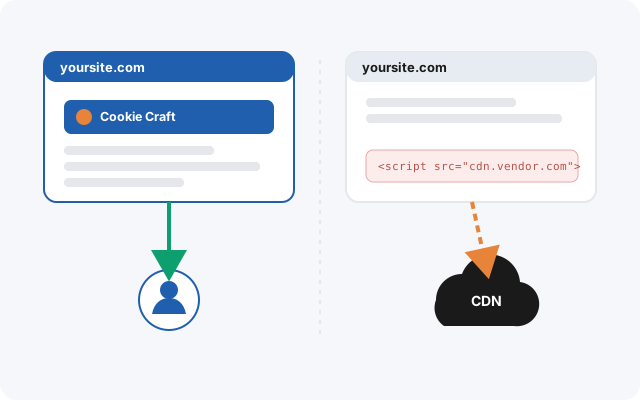
Shopware buyers care about what runs on their infrastructure. The local-first architecture is a genuine argument for them, not a marketing line: no third-party script on the storefront, no external CDN in the critical rendering path, and consent records stored in their own database.

For a platform whose audience reads your claims carefully, being able to say “nothing loads from us on your customer’s page” — and have them verify it in the Network tab — is worth more than a feature list.

What it does — and what it doesn’t

Cookie Craft does not scan your Shopware site to discover cookies automatically, and it does not write your privacy policy for you. It gives you the mechanism: a banner your visitors actually interact with, real blocking of the scripts you configure, and correct Consent Mode v2 signals to Google. What you declare in it is up to you.

Consent for Shopware, done properly.

Self-hosted, first-party, and everything included — €25/month or €240/year per root domain.